
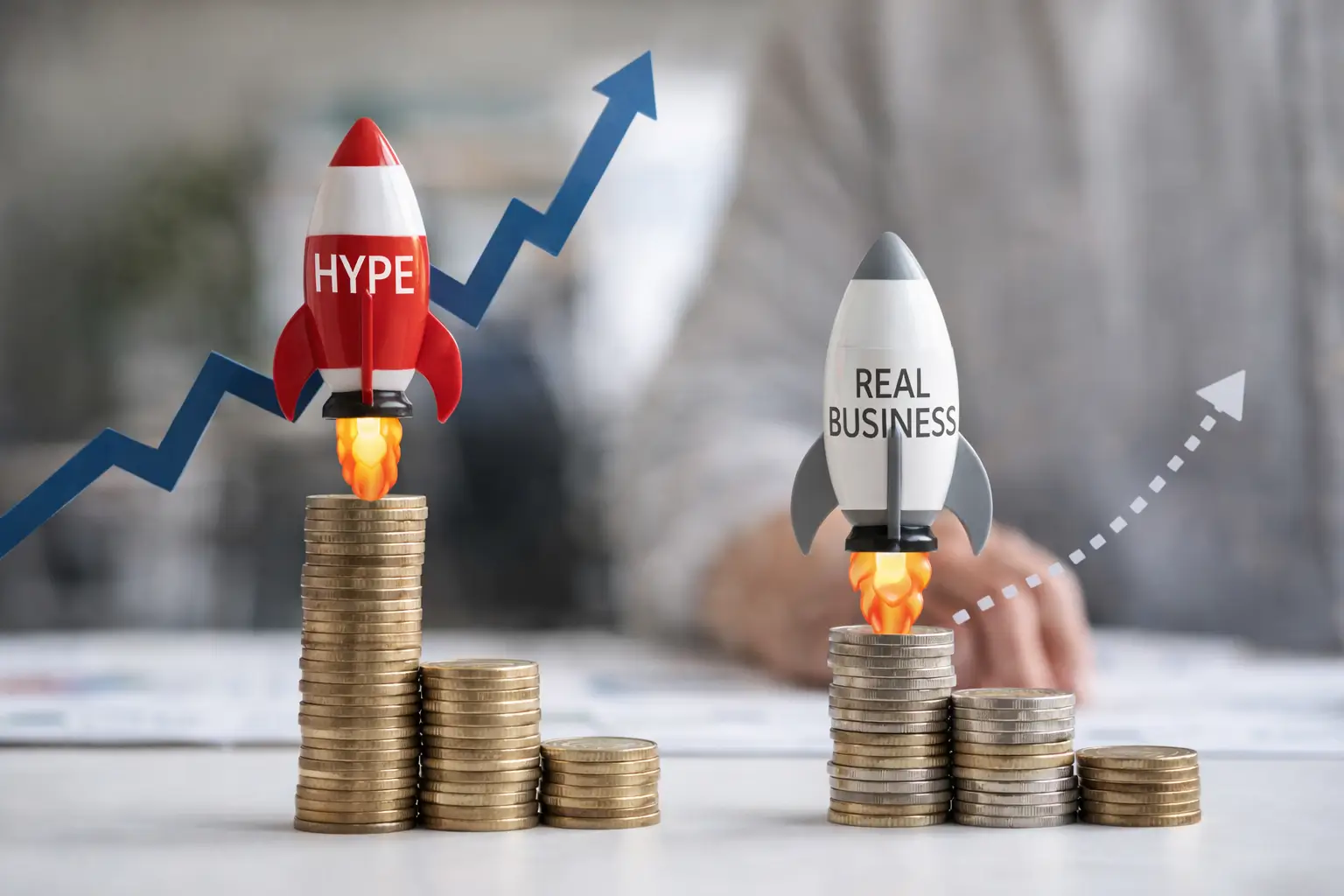
Why hype creates distorted expectations around growth
One of the easiest ways for entrepreneurs to lose perspective is to spend too much time around business hype. Online, growth is often presented as a dramatic jump. Someone suddenly scales. A brand seems to appear overnight. A founder shares a revenue screenshot, a big milestone, or a polished story that makes momentum look sharp and immediate.
What usually gets left out is the timeline underneath it. The slow months. The unclear positioning. The offers that did not convert well at first. The repeated improvements that made the result possible. The internal stress. The operational mess. The years of learning that do not fit neatly into a post.
That selective storytelling shapes expectations more than many founders realize. It creates the impression that real success should move faster, look more obvious, and feel more exciting than it often does. As a result, entrepreneurs can start treating normal business growth as failure simply because it does not resemble the pace of online narratives.
This is one of the quiet dangers of hype. It does not just exaggerate what is possible. It makes healthy progress feel insufficient. A business that is improving steadily can start to seem disappointing if the founder is measuring it against stories designed to create emotional impact rather than realistic understanding.
Real businesses grow through repetition, not constant breakthroughs
Most sustainable businesses are not built on endless breakthrough moments. They are built through repetition. Repeating good service. Repeating clear communication. Repeating consistent delivery. Repeating follow-up. Repeating improvement. Repeating useful marketing long enough for trust to build.
That process is less glamorous than people expect, but it is usually much closer to reality.
A founder may need months to refine an offer so it actually connects. A content strategy may take time before it starts attracting the right audience. A customer base may grow slowly because trust takes repeated contact, not one good week. Backend systems may need to be improved gradually so growth does not create chaos. None of this feels dramatic day to day, but it is often exactly what creates long-term strength.
This is where many entrepreneurs get discouraged too early. They are looking for signs of dramatic acceleration while overlooking the value of steady repetition. They mistake slow traction for weak potential when, in fact, slow traction is often how real businesses become durable.
Fast results can happen, of course. Some products catch quickly. Some launches land well. Some markets respond fast. But even then, the business that lasts usually depends on slower layers underneath, like systems, judgment, trust, and operational maturity. The visible spike is only one part of the story.
Slow growth often means the business is becoming more real
There is a stage in business where growth stops feeling theoretical and starts becoming operational. This is where many founders feel tension. On paper, they want growth. In practice, growth starts demanding better decisions, better structure, better messaging, better delivery, and more emotional steadiness than before.
That is one reason real businesses often grow slower than hype suggests. Reality introduces friction.
Customers ask questions you did not expect. Delivery takes longer than planned. Marketing needs more testing. Margins are not as simple as revenue makes them appear. Audience building takes longer than one viral moment. Technology breaks. Support becomes more complex. Personal energy has limits. Life does not pause just because the business has goals.
These are not signs that something is wrong. They are signs that the business is moving beyond fantasy and into actual operation.
A business that grows in the real world has to carry weight that hype rarely mentions:
– Clearer processes
– Better customer experience
– Stronger financial decisions
– More stable execution
– Smarter priorities
– Greater patience with what takes time
In that sense, slower growth is not always disappointing. Sometimes it is evidence that the business is developing depth instead of just surface momentum.
Why entrepreneurs get tempted to rush what should be built properly
When founders absorb too much hype, they often start pressuring the business to move at an unnatural speed. They want every offer to prove itself immediately. They expect every new channel to work fast. They judge each month too harshly. They change direction before anything has had enough time to mature.
This creates a cycle of unnecessary instability.
Instead of improving a promising offer, they replace it too soon. Instead of giving marketing time to compound, they abandon it after a short period. Instead of strengthening what is already working, they chase a shinier direction because slower growth feels emotionally uncomfortable.
That discomfort matters. Slow growth can trigger doubt because it forces you to live without dramatic evidence for a while. You have to keep building before the results are loud enough to reassure you. That is one of the most demanding parts of entrepreneurship. Not the absence of potential, but the patience required to let real traction form.
A few signs that hype may be distorting your judgment:
– You feel behind even though your business is improving
– You keep changing strategy before you have enough real data
– You focus more on speed than on strength
– You dismiss gradual wins because they do not look impressive online
– You are more influenced by public stories than by your own actual numbers
These patterns can quietly weaken a business that might have grown well with a steadier mindset.
How to respect the slower rhythm of real growth
Entrepreneurs do better when they learn to read progress more honestly. That means looking beyond dramatic moments and paying attention to signs of real strengthening.
Useful questions include:
– Is the offer clearer than it was three months ago?
– Are customers responding with more trust or fewer objections?
– Is delivery becoming easier or more consistent?
– Are my decisions improving, even if the numbers are still uneven?
– Is the business becoming more stable, more focused, or more repeatable?
These questions matter because they capture forms of growth that hype usually ignores. Better positioning. Better retention. Better execution. Better clarity. Better margins. These may not create flashy screenshots, but they often matter more than short bursts of attention.
It also helps to define what kind of growth you actually want. Some founders say they want fast growth when what they really want is reliable growth. Others say they want scale when what they really need first is a cleaner model. If you are not careful, hype can push you toward goals that sound exciting but do not fit the business you are actually trying to build.
Real growth usually asks for a calmer mindset. Less obsession with appearing successful. More commitment to becoming solid. Less emotional dependence on quick validation. More willingness to let trust, skill, and structure build over time.
Conclusion
Real businesses usually grow slower than hype because real businesses have to work in reality, not in storytelling. They need trust, refinement, systems, patience, and repeated proof that the value holds up over time. That slower pace can feel frustrating if you are comparing yourself to polished narratives online. But very often, it is the slower business that becomes the stronger one. The goal is not to grow with the most drama. It is to grow in a way that can last, support your life, and still make sense when the hype moves on to something else.












0 Comments